Sport news
This weekend in Azerbaijan, Formula 1 will introduce a new format designed to boost the spectacle of Sprint weekends and improve track action for fans around the world. Thanks to the close working relationship the FIA enjoys with FOM as well as the sport’s 10 teams and power unit manufacturers, moving the changes from concept to regulatory reality has been accomplished swiftly and positively through collaboration.
But how does this whole process work? The answer lies in a streamlined, but carefully constructed process that promotes agility while at the same time providing the precision and foresight required at the pinnacle of motor sport.
Stage 1: F1 Commission: Development for the future
Responsible for all matters relating to the FIA Formula One World Championship, including amendments to the regulations governing the sport, the F1 Commission is where ideas aimed at improving the championship are generated or first tabled.
Composed of one member representing the FIA, one representing the Commercial Rights Holder (FOM), one each from the sport’s 10 teams, as well as one member representing each of the four existing power unit manufacturers, the F1 Commission meets at least three times per year, usually before meetings of the FIA World Motor Sport Council (WMSC).
Chaired alternately by the representative of the FIA and FOM, the F1 Commission distributes a single vote to each Team Member, while the FIA and FOM each have a number of votes equal to the number of teams taking part in the Championship. In the case of amendments to the Power Unit Regulations, the representatives of the PU Manufacturers are each granted a vote.
For a concept to progress to the next stage, a majority is required. In the case of F1’s Sporting and Technical Regulations, the vote must be made prior to the end of April of the year preceding the introduction of the proposed regulatory change and a simple majority of 25 of the 30 available votes is required. However, if the change is tabled after the end of April of the year preceding introduction of the regulatory change, a super majority of 28 votes is required. When it comes to changes to the PU regulations the majorities are the same, plus, in each case, an affirmative vote by not less than 50% of the PU Manufacturer representatives.
Regarding the Financial Regulations, the vote must made prior to the end of September of the year preceding the introduction of the aimed regulatory change and, again, a simple majority of 25 of the 30 available votes is required. However, if the change is tabled after the end of September of the year preceding introduction of the regulatory change, a super majority of 28 votes is required. However, amendments to the regulations for safety reasons can be made without following the above procedure (see below).
In the case of the alterations to the shape of Sprint weekends, the concept of creating an additional qualifying session to set the grid for the Sprint, was first presented at the F1 Commission’s meeting in London on 21 January 2023. As the change has been made for the current season a super majority was required to implement the regulatory change. In this instance approval was unanimous.
Stage 2 – F1 Advisory Committees: Driven by detail
Once approved by the F1 Commission, the regulatory concept is forwarded to one (or more in the case of rules that cross competencies) of the four F1 Advisory Committees: the F1 Sporting Advisory Committee (SAC) in respect of amendments to the F1 Sporting Regulations; F1 Technical Advisory Committee (TAC) in respect of amendments to the F1 Technical Regulations; F1 Financial Advisory Committee (FAC) in respect of amendments to the F1 Financial Regulations, and the F1 PU Advisory Committee (PUAC) in respect of amendments to the F1 PU Regulations.
Each Committee is comprised of relevant experts from the FIA, FOM, the F1 Teams and the PU Manufacturer, with Team Sporting Directors (SAC), Technical Directors (TAC), Financial Directors (FAC) and representatives of the PU suppliers each bringing their expertise to the table.
While they have no executive function, the role of the F1 Advisory Committees is to consider the proposals of the F1 Commission in light of the proposal’s likely impact across the sport and to frame the text of regulations that encompass the proposal and deal with any knock-on effects within existing regulations affected by proposed changes.
Once the Advisory Committees have completed a draft regulation this is returned to the F1 Commission for consideration. Should the F1 Commission feel the draft requires further changes it will return it to the Advisory Committees for review. Should the draft meet with the approval of the F1 Commission it is then forwarded to the WMSC for ratification.
Following its January meeting, the F1 Commission members referred the F1 Sprint weekend proposal to the SAC, which was discussed at the SAC’s meeting of 23 March 2023. An additional meeting between the FIA, FOM and the F1 Teams was convened on 12 April 2023 in Melbourne on the occasion of the Australian Grand Prix to confirm that the initial direction plotted out in the SAC meeting was going to achieve the goals set out by the F1 Commission for this project. The meeting concluding positively; thus, an additional SAC was convened on 13 April 2023 to finalise the wording of the regulatory proposals.
Stage 3 – World Motor Sport Council: Decisions at the Highest Level
The highest decision-making body within the FIA, the WMSC is responsible for all aspects of international motor sport.
Composed of the FIA President, the FIA Deputy President for Sport, the seven FIA Vice-Presidents, as well as 14 titular members and five members by right, including FOM. Even though the F1 Commission delegate is not a member of the WMSC, he or she shall vote at the WMSC on F1 matters only, exercising the vote of the President of the FIA Manufacturers’ Commission.
Meeting at least three times a year the WMSC decides on rules and regulations, safety and the development of all motor sport disciplines.
The WMSC can also enact changes via e-vote at any time, as occurred with the regulatory changes being brought into force this weekend in Baku. Following the F1 Commission meeting of 25 April, at which the final draft regulation governing the changes to Sprint weekends was approved, the proposal was then submitted via e-vote to the WMSC , which ratified the implementation of the regulatory changes at the Azerbaijan Grand Prix.
Additional stage – FIA: Safety first
The improvement of safety in motor sport, for competitors, officials and spectators, is a guiding principle of FIA activity, and while the route to regulatory change follows a carefully prescribed path, there is provision made for unilateral adjustment of the rules on the grounds of safety.
The FIA may, without approval of the F1 Commission, amend the F1 Sporting Regulations and/or F1 Technical Regulations, and make consequential changes to the F1 Financial Regulations, at any time as it considers necessary for safety reasons, provided that the relevant F1 Advisory Committees are consulted in advance and the amendments are proposed to the WMSC by the FIA and approved by the Council.
And how are these rules applied?
There is a common misconception that FIA Officials, such as the Race Director, are responsible for handing out penalties for non-compliance with FIA Regulations. In fact, the easiest way to think about the way this works is the same way the judicial process works in most countries – with a police force and an independent judicial system. All F1 regulations are ‘policed’ by FIA Officials, such as the Race Director, Technical Delegate, FIA software engineers and even the FIA Media Delegate. Then, in the event of an alleged breach in the regulations, it is reported to the independent panel of judges, or Stewards as we call them in Formula 1, who deliberate and take a decision after having analysed the case.
FIA Formula One World Championship
Formula 1F1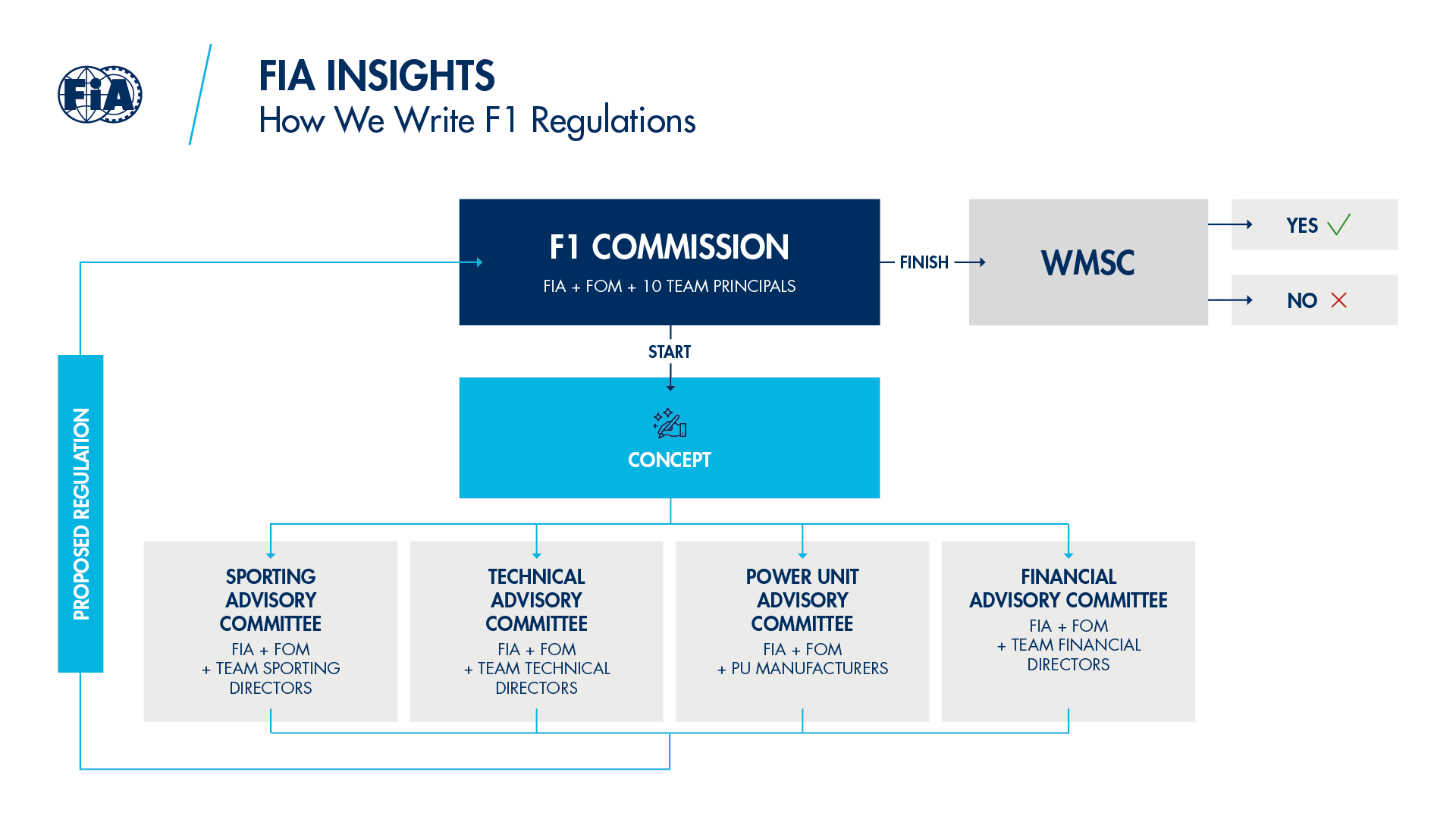 SEASON 2023SportCircuit1SportFIA Formula One World ChampionshipCircuitF1SEASON 2023Formula 100Thursday, April 27, 2023 – 1:59pmThursday, April 27, 2023 – 1:59pm