Sepang’s return to the Formula 1 calendar brings one of the most complete physical and technical tests in racing. Its sweeping layout features long straights, heavy braking zones, and technical highlights like the sweeping Turns 5 and 6 and the tricky Turn 15 hairpin.
Beyond the track itself, South East Asia’s extreme heat, rough asphalt, and volatile tropical weather ensure that qualifying grid positions offer no guarantees come Sunday.
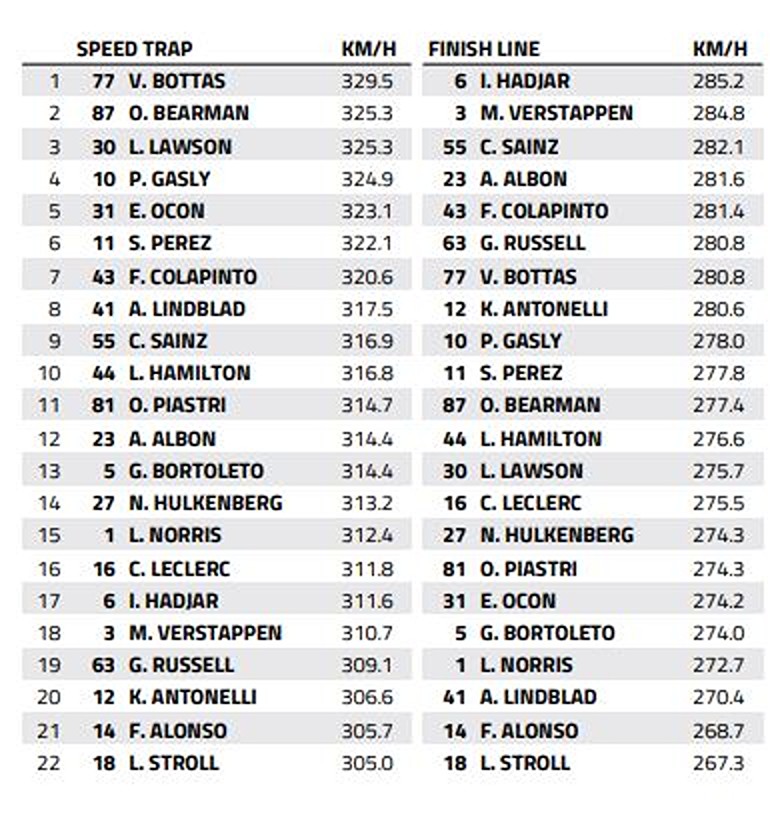
The speed trap figures from Saturday’s qualifying session unsurprisingly highlight stark differences in downforce configurations and engine setups across the field.
Valtteri Bottas comfortably topped the speed trap at 329.5 km/h, followed by Oliver Bearman and Liam Lawson both hitting 325.3 km/h. High straight-line figures suggest a low-downforce setup aimed at defending or attacking on Sepang’s wide straights.
By contrast, the front-runners sat far down the top-speed rankings as most prioritized aero efficiency. Pole-sitter Max Verstappen logged just 310.7 km/h (18th), despite his Red Bull Powertrains/Ford unit breaking Mercedes’ 15-race pole streak.
Front-row partner Lewis Hamilton managed 316.8 km/h (10th), while Charles Leclerc (311.8 km/h) and Kimi Antonelli (306.6 km/h) likely dialed in higher downforce levels to protect their tyres through Sepang’s high-energy lateral corners.
Tyre allocation dilemmas
Pirelli’s recommended baseline strategy is a two-stop Medium > Hard > Hard approach (pit windows around Laps 12–18 and Laps 32–38). Alternatively, strong practice performance from the C4 compound makes a Soft > Hard > Hard progression viable (first stop Laps 10–16).
Crucially, neither pole-sitter Max Verstappen nor 4th-placed Charles Leclerc retained two sets of Hard tyres. Having kept only one set of Hards and one set of Mediums, both drivers are locked into integrating the Soft tyre into their race plan. Their options include:
Two-Stop Option: A Soft > Hard > Medium sequence (first stop Laps 11–17, extending the Hard stint to Laps 34–40).
Three-Stop Option: A more aggressive Soft > Hard > Hard > Medium strategy (stops around Laps 7–13, 24–30, and 41–47), or a softer multi-stop combination capitalizing on the surprisingly durable C4 Soft.
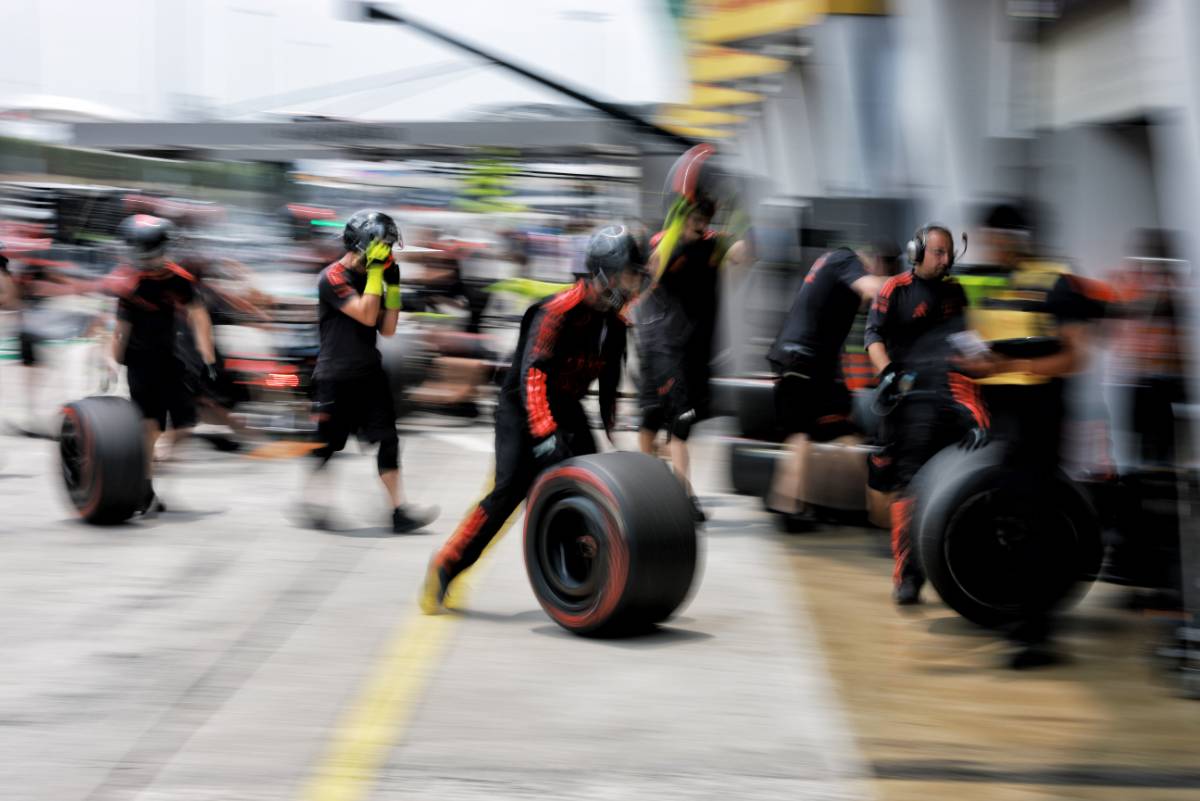
Pirelli Motorsport Director Dario Marrafuschi noted that the rough asphalt suits the C4 Soft far better than in Baku, offering consistent pace over longer stints if drivers manage their initial out-laps gently. But the Italian reckons that all three of its compounds will see action on Sunday.
“Probably part of the grid will be a medium>double hard; part of the grid will use all the three compounds with the two stoppers; and part of the grid will go to three stops, using all the three compounds,” he said.
The weather wildcard
A 24-second pit loss makes three-stop strategies a calculated gamble, but Sepang’s unpredictable microclimate could force everyone’s hand.
With a 40% chance of sudden tropical rain showers and no full-wet sessions completed so far this season, any sudden downpour would instantly throw all pre-race calculations out the window.
Verstappen starts on pole, but with Hamilton, Antonelli, and Leclerc breathing down his neck and divergent tyre strategies across the top four, Sunday’s Grand Prix promises pure drama from lights out to the chequered flag.
Keep up to date with all the F1 news via X and Facebook
The post Sepang Speed Trap: Who is the fastest of them all? appeared first on F1i.com.